
Table of Contents
- Why Dry, Damaged Hair Needs More Than Regular Conditioner
- Best Hair Masks for Dry Damaged Hair: What to Look For
- How to Apply Hair Mask Correctly for Maximum Repair
- How Often to Use Hair Mask on Dry, Damaged Hair
- What Happens If You Leave Hair Mask On Too Long?
- Professional vs. Drugstore Hair Masks: What Actually Matters
- Choosing Authentic Professional Haircare in Malta
- Conclusion
- Frequently Asked Questions
Last Updated: September 21, 2026
Why Dry, Damaged Hair Needs More Than Regular Conditioner
Regular conditioner coats the surface, smoothing the cuticle and adding shine, but it doesn’t repair what’s broken inside the strand. That’s the problem with relying on conditioner alone for dry, damaged hair.
Conditioner maintains. Masks repair. If your hair is already dry and damaged, you need both, but the mask is doing the heavy lifting.
Best Hair Masks for Dry Damaged Hair: What to Look For
The best hair masks for dry damaged hair balance three ingredient types: humectants, emollients, and proteins. Get it wrong and hair stays dry or becomes brittle from protein overload. But “damage” isn’t one thing, chemical, heat, and mechanical damage each break the shaft differently and respond to different actives. Match the ingredient to the damage type, not just the word “dry.”
Humectants, Emollients, and Proteins: Reading the Label
Humectants attract and hold water inside the shaft: glycerin, honey, aloe vera, panthenol (provitamin B5), and sodium PCA. They’re hydration workhorses, especially for low-porosity hair. In very dry climates, though, glycerin can pull moisture out of the hair if the air is drier than the strand.
Match the Ingredient to the Damage Type
The right mask depends on how your hair got damaged:
- Chemical damage (bleach, color, relaxers): The cuticle is lifted and internal bonds are broken. Prioritize bond builders plus hydrolyzed proteins, with emollients to seal. Protein-forward formulas are appropriate here.
- Heat damage (flat irons, blow dryers, hot tools): The cuticle is cracked and moisture escapes fast. Prioritize humectants plus lightweight emollients, with moderate protein. Heavy protein on heat-damaged but otherwise healthy hair can make it brittle.
- Mechanical damage (brushing, tight styles, friction): Shows as split ends and mid-shaft breakage. Prioritize emollients and humectants for flexibility; protein helps but only a trim fixes a split end.
- Environmental dryness (sun, hard water, winter air): Often low-porosity hair that just can’t hold moisture. Humectant-heavy, low-protein masks work best, applied with gentle heat.
Matching Masks to Hair Porosity and Texture
Your hair porosity determines how well a mask absorbs and which formula works for you.
- Low porosity: Cuticles lie flat and resist moisture. Choose lightweight humectant-heavy masks and apply with gentle heat (warm towel or shower cap) to lift the cuticle. Avoid heavy butters and high-protein formulas, which sit on top and cause buildup.
- Medium porosity: The sweet spot. Most balanced masks work well here.
- High porosity: Hair absorbs moisture fast but loses it just as quickly. Use protein plus heavy emollients to seal the cuticle. Bond builders help especially if the porosity comes from chemical or heat damage.
Test your porosity at home: drop a clean strand of hair into a glass of water. If it sinks quickly, you have high porosity. If it floats for minutes, you’re low porosity. This one test changes which mask you should buy, and how long you should leave it on.
How Porosity Changes Application Time
Porosity also changes how you use a mask. Low-porosity hair often needs 20-30 minutes with heat to absorb anything meaningful, while high-porosity hair saturates in 5-10 minutes and can start losing moisture if left too long under a warm cap. Treat “5-20 minutes” as a range to tune to your porosity, not a fixed rule.
How to Apply Hair Mask Correctly for Maximum Repair
Apply to clean, damp hair from mid-lengths to ends, avoiding the scalp unless the product is designed for scalp health. Leave on for the stated time, then rinse thoroughly with cool water.
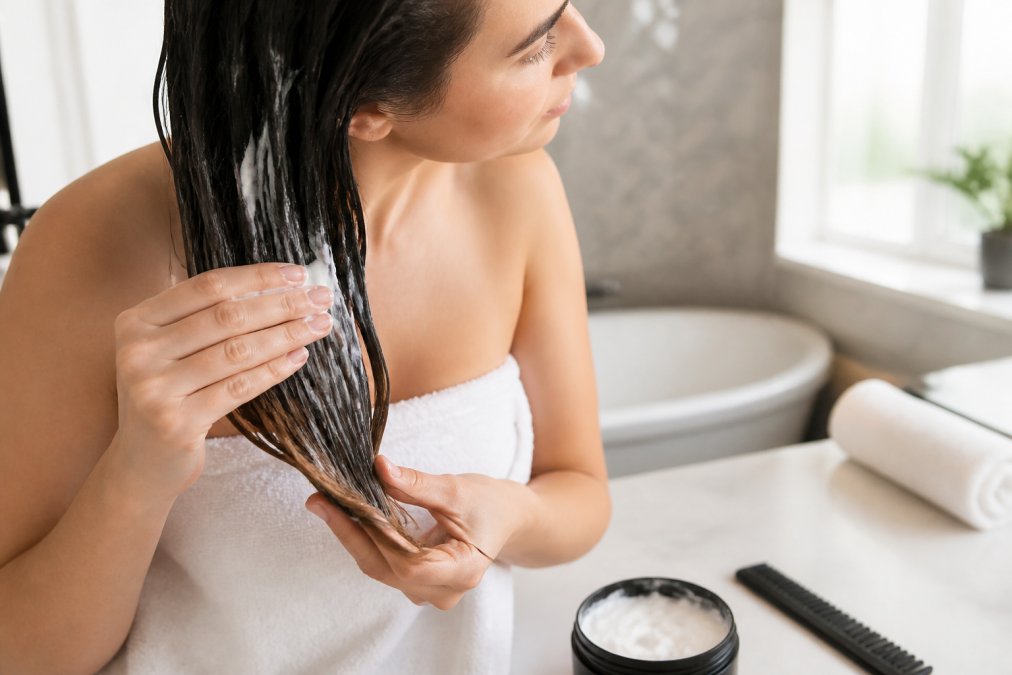
Here’s the full process:
- Shampoo first. Masks work best on clean hair because oils and product buildup block absorption.
- Towel-dry to damp. Sopping wet hair dilutes the mask. Squeeze out excess water.
- Section your hair. Use clips to work in four to six sections so no strand gets missed.
- Apply mid-length to ends. These are the oldest, driest parts. Use a wide-tooth comb to distribute evenly.
- Wait the full time. Most masks need 5-20 minutes.
- Rinse with cool water. Cool water seals the cuticle and locks in shine.
- Follow with leave-in if needed. For very dry hair, it adds a final layer of protection.
How Often to Use Hair Mask on Dry, Damaged Hair
Use a hair mask once or twice a week for dry, damaged hair. If hair is severely compromised by chemical damage or heat styling, start twice weekly for a month, then drop to once weekly for maintenance.
| Hair Condition | Frequency | Mask Type |
|---|---|---|
| Mildly dry | Once weekly | Moisture-focused |
| Moderately damaged | Twice weekly | Balanced moisture + protein |
| Severely damaged | Twice weekly, then weekly | Protein-forward, then balanced |
| Fine, dry hair | Once weekly | Lightweight humectant |
| Coarse, dry hair | Twice weekly | Rich emollient + protein |
What Happens If You Leave Hair Mask On Too Long?
Leaving a hair mask on too long can cause protein overload, moisture imbalance, and sometimes scalp irritation. Most masks work within a 5-to-20-minute window; past that, ingredients stop helping and start causing problems.
Here’s what happens when you over-mask:
- Protein overload: Hair becomes stiff, brittle, and more likely to break. This is the most common issue.
- Moisture imbalance: Hair feels mushy and stretches instead of bouncing back.
- Scalp irritation: If the mask touches your scalp, extended contact can clog follicles or trigger sensitivity.
- Product waste: The hair can only absorb so much. The rest just sits there.
Never sleep in a hair mask unless the product specifically says it’s designed for overnight use. Standard rinse-out masks left on for hours can cause significant protein overload and breakage.
Professional vs. Drugstore Hair Masks: What Actually Matters
Professional and drugstore masks differ less in marketing than in formulation concentration, ingredient quality, and delivery system. Salon-grade products typically use higher concentrations of actives and fewer fillers, not automatically better for every hair type, but it matters for damaged hair needing real repair.
What Actually Differs in the Formula
- Active concentration: Professional masks often list proteins, humectants, and oils higher on the INCI list, meaning they make up a larger share of the formula. Drugstore masks frequently lead with water, silicones, and thickeners.
- Silicone load: Many drugstore masks rely on dimethicone and amodimethicone for instant slip and shine. Silicones reduce friction and protect damaged cuticles, but a heavy load masks damage rather than repairing it and builds up without clarifying.
- Preservative and fragrance choices: Professional lines are more likely to be sulfate-free, pH-balanced, and formulated for color-treated hair. That matters if you’ve paid for color you want to keep.
- Delivery format: Some professional masks use emulsions or micro-emulsions designed to penetrate more evenly. Drugstore masks are more likely to be simple creams.
The Price-Per-Ounce Reality
Professional masks cost more per jar but need less product per use because they’re more concentrated. A cheaper drugstore mask may need two or three times the amount for the same hair, narrowing or erasing the gap. Compare price per ounce and uses per jar: if a professional mask lasts three months and a drugstore one lasts one, professional is often cheaper per wash day.
When Professional Is Worth It, and When It Isn’t
- Worth it: Color-treated hair, chemically damaged hair, high-porosity hair that needs bond builders, and anyone who wants predictable results without trial-and-error.
- Not necessary: Mildly dry hair with no chemical or heat damage, fine hair that responds well to lightweight humectant masks, and anyone who’s willing to read labels carefully and clarify regularly.
For color-treated hair, professional masks are usually safer: more likely sulfate-free and pH-balanced, which preserves color and reduces fading. If unsure, use a professional mask for the repair phase, then maintain with a well-formulated drugstore option once hair stabilizes.
The professional-vs-drugstore question isn’t about brand tier, it’s about concentration, pH, and delivery. Read the INCI list, compare price per ounce, and match the formula to your damage type and porosity. That beats any label claim.
Choosing Authentic Professional Haircare in Malta
Authenticity is the real issue when buying professional haircare in Malta. Counterfeit and diluted products circulate online and often look identical to the real thing, the difference shows up in your hair over weeks, not days.
Conclusion
Dry, damaged hair needs more than a better conditioner: the right mask, applied correctly, at the right frequency, from a source you can trust. Get those four things right and you’ll see the difference within a month.
Frequently Asked Questions
What hair mask is best for very dry, damaged hair?
The best hair masks for dry damaged hair contain a mix of humectants like glycerin to draw in moisture, emollients such as natural oils and botanical extracts to smooth the hair cuticle, and hydrolyzed proteins to temporarily patch split ends and improve hair elasticity. For color-treated or chemically damaged hair, look for masks with a balanced pH and no drying alcohols. If your hair is brittle and snaps easily, a protein-forward mask used every two weeks alongside a moisture mask works well. Always check that the formula is designed for your porosity level.
How often should you use a hair mask for damaged hair?
For dry, damaged hair, use a rinse-out hair mask once or twice a week. If your hair is severely damaged from heat styling or chemical treatments, start with two applications per week for the first month, then reduce to once weekly for maintenance. Fine or low-porosity hair should stick to once a week or every ten days to avoid weighing strands down. High-porosity hair can handle twice weekly because it absorbs and loses moisture faster. Adjust based on how your hair feels after each wash.
How do I rehydrate my dry hair between washes?
Between wash days, use a leave-in treatment or a lightweight hair oil on the mid-lengths and ends. Spritz dry strands with water first, then seal with a few drops of oil to lock in that moisture. Avoid applying heavy products to the roots, which can make your scalp look greasy. If your hair feels straw-like, a small amount of a rinse-out mask applied to dry ends for ten minutes before showering can act as a pre-wash treatment. Drink enough water and use a satin pillowcase to reduce friction overnight.
Can I leave a hair mask on overnight for better results?
Leaving a rinse-out hair mask on overnight is not recommended unless the product is specifically labeled as an overnight or leave-in mask. Rinse-out formulas are designed to work within 10 to 30 minutes. Beyond that, humectants can pull moisture out of the hair in dry environments, and proteins can make strands stiff and prone to breakage. If you want deeper conditioning, apply the mask, cover with a shower cap, and use gentle heat for 20 minutes instead. Always follow the manufacturer’s instructions for the best results.